
Commercial Variable Recurring Payments for modern rail operators.
Replace stored cards and expensive direct debits with secure Open Banking payments. Bank on File lets passengers authorise one consent and travel seamlessly, while operators collect fares in real time.
The future of rail ticketing starts with the bank account.
Every journey shouldn’t require another card payment.
Bank on File enables passengers to securely connect their bank account once using commercial Variable Recurring Payments (cVRP). After consent is given, operators can collect approved fares automatically without repeatedly asking customers to authenticate.
The result is faster journeys, lower payment costs and a better passenger experience.

About Us
Built for modern rail travel
- Account-on-file instead of card-on-file – Passengers securely authorise their bank account once.
- Frictionless repeat travel – Daily commuters simply tap, travel and go.
- Real-time account-to-account payments – Funds move directly between bank accounts using Open Banking.
- Lower payment costs – Reduce card interchange fees and chargeback exposure.
- Flexible fare collection – Collect the correct fare after travel, including fare capping and journey adjustments.
- Customer control – Passengers can view, manage or revoke payment consent at any time.
Card on File was built for cards.
Bank on File is built for modern Pay-by-Bank payments. ⚡
Frequently Asked Questions
What are Commercial Variable Recurring Payments (cVRP)?
Commercial Variable Recurring Payments (cVRP) are a new open banking payment method that allows businesses to collect recurring payments directly from a customer’s bank account with the customer’s consent.
Customers authorise the payment relationship once, and businesses can then initiate future payments within agreed limits without requiring re-authentication each time.
They combine the security of open banking payments with the convenience of recurring payments, similar to Direct Debit or card-on-file payments.
How do cVRPs work?
The process usually follows four steps:
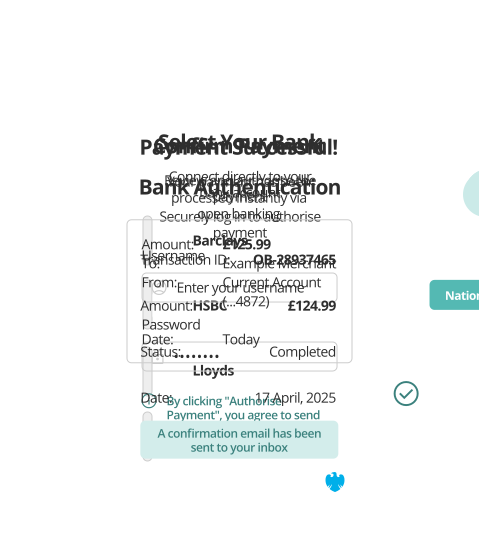
- Customer consent — The customer authorises a business to take payments from their bank account via their banking app.
- Consent parameters — Limits are defined (e.g. maximum payment amount, frequency, or time period).
- Long-lived authorisation — Once set up, payments can be initiated without requiring the customer to re-approve each one.
- Real-time payments — Payments are processed directly from bank account to bank account via open banking rails.
What is the difference between VRP and cVRP?
There are two main types of VRP:
Sweeping VRP: Transfers between accounts owned by the same person (e.g. moving money between current and savings accounts).
Commercial VRP (cVRP): Allows businesses to collect payments from customers’ bank accounts for goods or services.
Sweeping VRP is already widely implemented, while cVRP extends the model to merchant payments.
What are the key benefits of cVRP for businesses?
- Lower payment costs — Payments go directly from bank to bank, bypassing card networks and associated fees.
- Instant or near-instant settlement — Funds can arrive within seconds instead of days.
- Higher payment success rates — There are no card expiries or failed card authorisations.
- Better customer experience — Customers only need to authorise once, enabling one-click payments thereafter.
- Flexible billing models — Businesses can collect variable amounts based on usage or consumption.
Ready to modernise rail payments?
Give passengers a faster, simpler way to pay while reducing payment costs across your network.
Book a demo
Questions?
Hello@bankonfile.com